



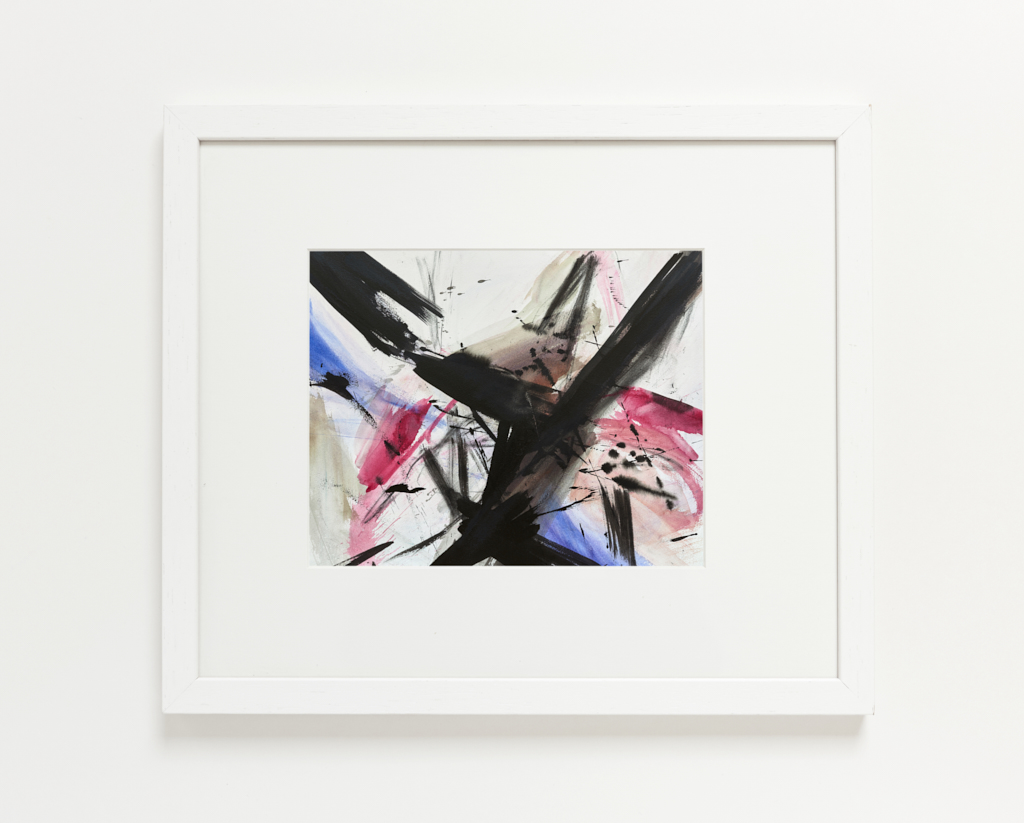
Artwork shown in an example frame (not to scale)
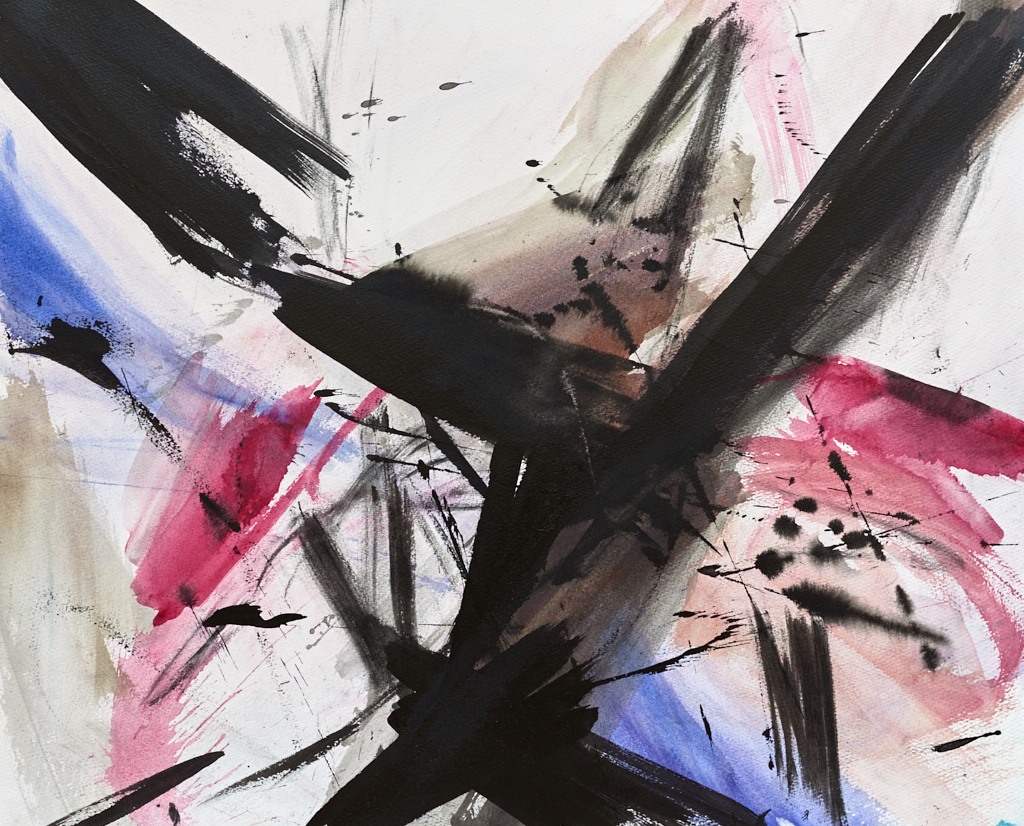
Counterpoise is an original abstract painting by Timothy Gent, created using watercolour, ink and charcoal on archival paper. A strong vertical axis anchors the composition, where translucent passages of magenta and blue intersect with darker charcoal and ink gestures. Weight and transparency, density and open paper are held in tension across the work.
Colour is developed through successive watercolour washes, allowing earlier layers and the natural luminosity of the paper to remain visible. Against this transparency, charcoal and ink introduce sweeping lines, broken gestures and concentrated passages of darker tone. Each medium retains its individual character while becoming increasingly interwoven across the surface, bringing colour, line and texture into close relationship.
Broad charcoal passages contrast with finer linear gestures, while washes accumulate, recede and overlap. Some lines extend decisively across the painting; others fragment or disappear into colour and exposed paper. Movement and restraint, density and openness are continually brought into balance, creating a composition in which contrasting elements remain visually connected.
Close viewing reveals the successive stages of the painting's development: transparent watercolour washes establish the underlying layers, followed by ink and charcoal marks applied over the colour. Some of these later gestures remain clear and decisive, while others break, soften or intersect with the washes beneath. Areas of exposed paper remain integral to the composition, bringing together the fluidity of the watercolour and the more immediate character of the drawn marks.
Created using professional artist materials on 300 gsm cold-pressed watercolour paper, Counterpoise is signed, titled and dated on the reverse and supplied with a certificate of authenticity.
Painted on 300 gsm cold-pressed watercolour paper, the sheet was secured throughout the painting process to maintain a stable, flat surface. As the composition extends close to the paper's edges, float framing or a minimal window mount is recommended to preserve the integrity of the artwork.